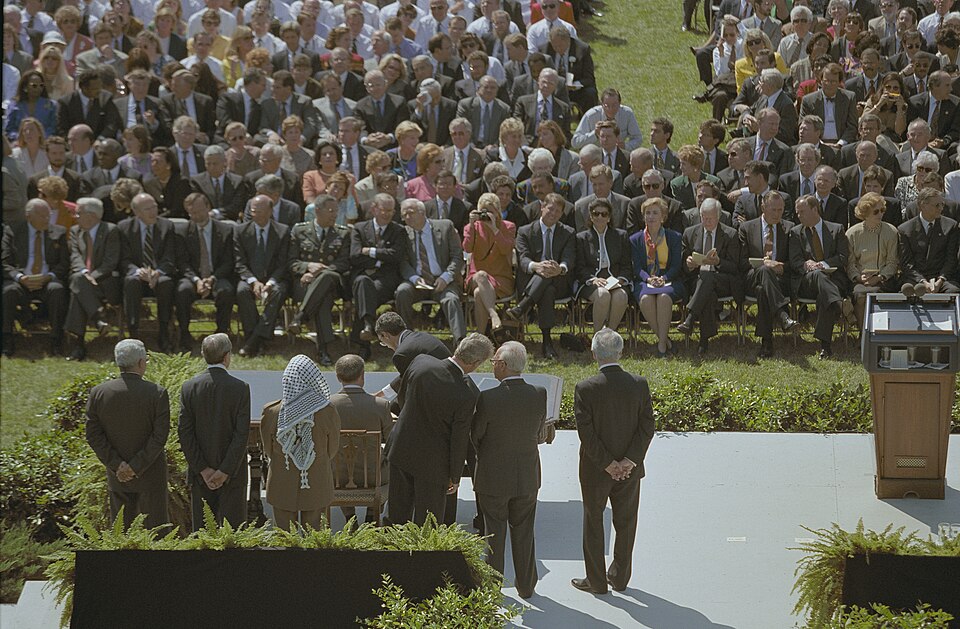
In September 1993, the world witnessed an event that was meant to steer a chapter of world history towards more peaceful paths: the historic handshake in Washington between the arch-enemies – Israel's Prime Minister Rabin and PLO Chief Arafat – was supposed to defuse the powder keg on which the Middle East had sat for over 50 years. According to the agreement, within five years, the borders of the State of Palestine were to be established and peaceful coexistence between the two neighbors was to begin.
But, as is well known, things turned out differently. Once the euphoria faded, it became clear that perhaps the powder keg was temporarily disarmed, but in Washington, a complete minefield was laid out before the Palestinian people on their path to self-determination. More than that, a fast lane was essentially built for the colonial settlement policy of the Israelis.
While the Palestinians were forced into dependence on the occupying power and aid from donor countries through numerous subsequent agreements, many doors opened for Israel. These included economic agreements with the EU, arms deliveries, aid loans from the USA, partial normalization with most Arab states, and so on and so forth.
The losers and winners of the 'de-escalation' adventure quickly became clear. The pseudo-peace was and remains a profitable business for Israel. For the Palestinians, it was and still is a venture on quicksand – dangerous and unpredictable.
The failure of the so-called Oslo Peace Accords was programmed. The signed agreements contained a ticking time bomb that might not have been visible at first glance but was audible. And it was highly explosive and thus destructive. Why? Because the agreements did not take into account the numerous UN Security Council resolutions dealing with the conflict. Both sides deliberately waived international control mechanisms to ensure compliance with the agreed steps – and thus the law of the stronger prevailed. The Palestinian territories were labeled as 'disputed territories,' whereas international law designates them as 'occupied territories.' This fact gave a tremendous boost to Israel's colonial settlement policy.
In summary, almost everything undertaken in the Oslo Peace Accords over the past two decades was dictated to the Palestinians, did not lead to peace, but rather to more tension and escalation.
Israel and its allies in the Western world must understand that they only have two paths in the future. Either Israel annexes the Palestinian occupied territories and waits until an apartheid system is fully established in the country, or Israel accepts the division of the historic land of Palestine into two states.
That is one side – but what does Palestine now need for a functioning peace? No magic, no empty words, and above all no double standards from the Western world. The people of Palestine simply need the implementation of international law regarding their own land. Actually quite simple, isn’t it?